Best CRM for Education Consultancy in Nepal: Complete 2026 Buying Guide
B
i am an sde
Search for a command to run...
No comments yet. Be the first to comment.
1. Hook Imagine a counsellor in a cramped Putalisadak office at 4:30pm. She opens three WhatsApp groups, two Excel files titled “Applications_v2_FINAL_really.xls” and a shared Gmail inbox. A student’s
Pathfinder CRM by Qylantis for Nepal Consultancies Imagine a counsellor in a cramped Putalisadak office at 4:30 PM. She has three WhatsApp chats open, two Excel files named something like Application
Qylantis Blog
3 posts
Notes on building software for South Asia
If you run an education consultancy in Nepal, you have probably already reached the point where Excel, WhatsApp, Gmail, and paper files are no longer enough.
Maybe a student's offer letter stayed inside a counsellor's personal Gmail for two weeks before anyone noticed. Maybe a counsellor left your company and took half the active leads with them because the leads were stored in their phone. Maybe your front desk received ten walk-in inquiries during an education fair week, but only four were followed up properly. Maybe you spent three days trying to find out which agent referred which student before paying commission. Maybe MoEST-related records were requested and your team had to search through old messages, Google Drive folders, random spreadsheets, and printed files just to prepare one report.
That is not just a messy process.
That is a business risk.
Most education consultancies in Nepal do not struggle because they cannot attract students. They struggle because their internal operation becomes chaotic as soon as the business grows. When you have 20 active students, a spreadsheet can survive. When you have 500 leads, 80 active applications, 12 counsellors, multiple destinations, different universities, visa stages, NOC tracking, payment records, agents, commissions, and branches, Excel becomes a liability.
This guide is for consultancy owners, directors, operations managers, counsellors, and branch managers who are searching for the best CRM for education consultancy in Nepal and want a practical, honest, and locally relevant way to choose the right system.
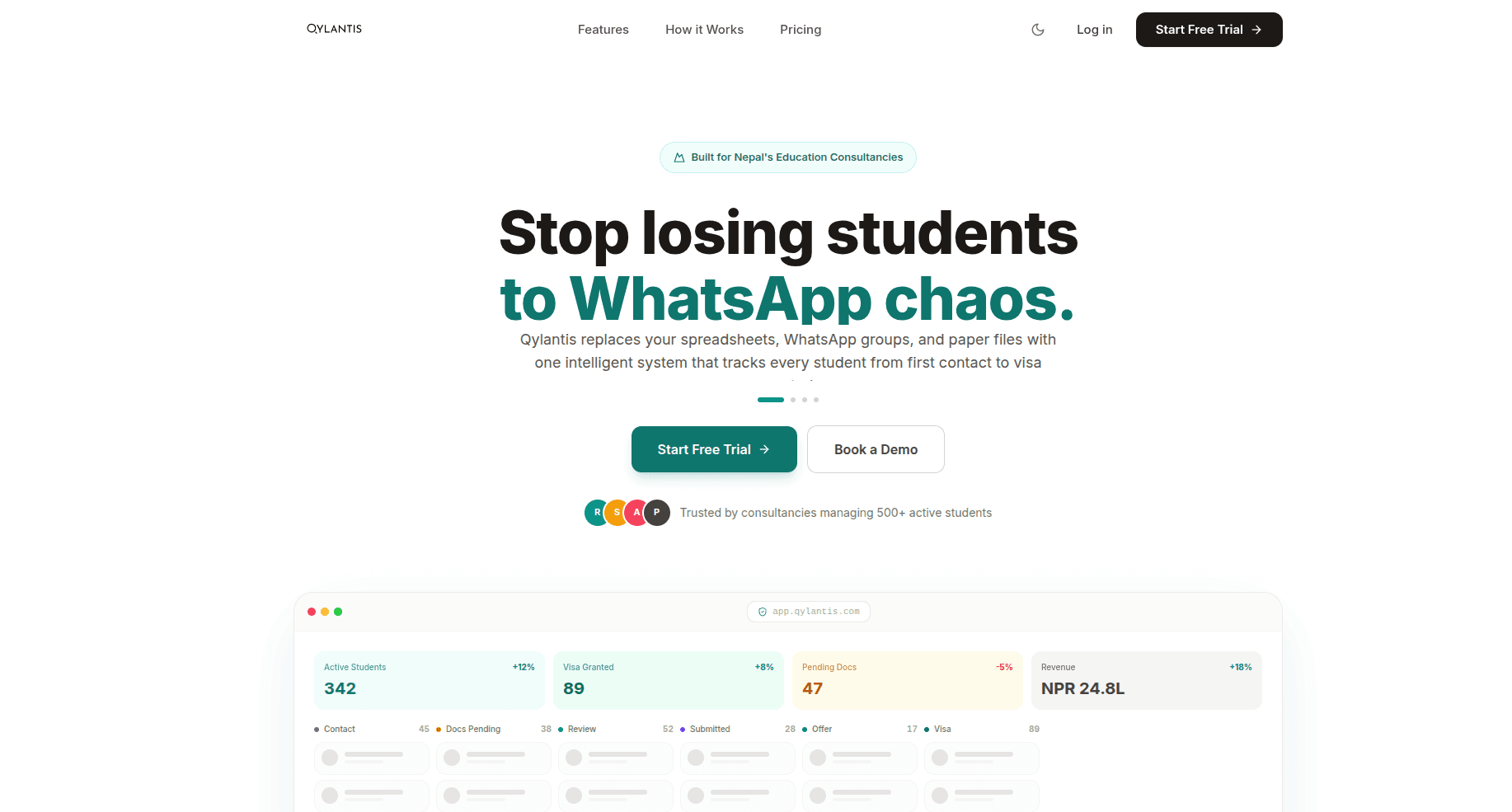
I am the founder of Pathfinder CRM by Qylantis, a CRM and student management platform built by Qylantis for Nepal's education consultancies. So yes, I have skin in the game. But this article is not only a product pitch. It is a serious buying guide for any consultancy owner who wants to understand what a CRM should actually do, why generic CRMs often fail in this market, what questions to ask vendors, what mistakes to avoid, and how Pathfinder CRM by Qylantis fits into the bigger picture.
By the end of this guide, you should be able to evaluate any CRM vendor with much better judgment.
A CRM, or Customer Relationship Management system, is software that helps a business manage relationships, communication, follow-ups, and workflows with customers.
But an education consultancy CRM is more specific.
For a study-abroad consultancy, the "customer" is not just a simple buyer. The student goes through a long journey:
Inquiry
Counselling
Destination selection
Course selection
University shortlisting
Document collection
Application submission
Offer letter
Financial preparation
NOC process
Visa file preparation
Visa submission
Visa decision
Pre-departure
Enrollment
Post-departure support
A normal sales CRM might only track contacts, deals, and follow-ups. That is not enough for an education consultancy.
A real education consultancy CRM should manage the full student lifecycle from first inquiry to final enrollment. It should help your team know who each student is, what they want to study, where they want to go, who is handling them, what documents are missing, what applications are active, what payments are pending, what visa stage they are in, and what action needs to happen next.
In simple words:
A CRM for an education consultancy should become the operating system of the consultancy.
It should not be just a digital notebook. It should not be just a fancy spreadsheet. It should not be just a place where counsellors enter names and phone numbers.
It should bring structure, visibility, accountability, and reporting to the entire consultancy operation.
Education consultancies in Nepal operate in a complex environment.
A consultancy is not just doing sales. It is managing students, parents, universities, documentation, payments, visa timelines, agents, counsellors, branches, and reporting.
A typical consultancy has to handle:
Student inquiries from walk-ins, phone calls, Facebook, TikTok, Google, website forms, referrals, education fairs, agents, and old students
Counselling for destinations like Australia, Canada, the UK, USA, Japan, South Korea, New Zealand, Europe, and other countries
Academic records, test scores, and eligibility checks
University and program shortlisting
Application forms and deadlines
Document collection and verification
Offer letters and conditions
NOC-related tracking
Visa preparation and submission
Payment collection
Receipt and invoice management
University commission tracking
Agent commission tracking
Counsellor incentives
Branch performance
Owner-level reporting
Trying to run all of this through Excel and WhatsApp is not professional enough anymore.
It creates predictable problems.
A student fills a website form. Another student sends a Facebook message. Someone calls the office. Someone walks in. Someone messages a counsellor on WhatsApp. Someone is referred by an old student.
If all these leads are not captured in one system, some will disappear.
That means lost revenue.
A student who is serious today may choose another consultancy tomorrow if your counsellor does not follow up.
Most consultancies lose students not because they gave bad advice, but because they followed up late or forgot completely.
A CRM solves this by showing:
Who needs to be called today
Which follow-ups are overdue
Which counsellor owns which student
Which leads are hot
Which students have gone silent
Which leads should be reactivated
Many consultancy owners are too dependent on verbal updates.
They ask:
How many leads came this week?
The team says:
Around 40.
They ask:
How many converted?
The team says:
Maybe 8 or 10.
That is not management. That is guessing.
A CRM gives owners actual numbers:
Total leads
Leads by source
Leads by counsellor
Leads by branch
Conversion rate
Lost leads
Pending follow-ups
Active applications
Payments collected
Revenue by branch
Counsellor performance
Without data, the owner cannot manage properly.
Education consultancy work is document-heavy.
Students submit passports, citizenship documents, academic transcripts, certificates, English test scores, financial documents, SOPs, recommendation letters, bank statements, income source documents, offer letters, visa documents, and more.
If documents are scattered across Google Drive, Gmail, WhatsApp, and physical folders, mistakes happen.
A CRM should show exactly what is missing, what is uploaded, what is verified, and what needs correction.
Consultancies collect money in different ways:
Cash
Bank transfer
eSewa
Khalti
Mobile banking
Cheque
Installments
They may charge:
Registration fees
Service fees
Application support fees
Documentation fees
Visa support fees
Other consultancy charges
If payments are not connected to student records, the owner cannot clearly see who has paid, who has not paid, and what amount is still pending.
This creates leakage.
If you have more than one branch, the problem multiplies.
You need to know:
Which branch is generating leads
Which branch converts better
Which counsellors are active
Which branch has pending payments
Which branch has stuck applications
Which branch has better visa success
Which branch needs support
A proper CRM should allow owners to see everything while branch managers only see their own branch data.
Many consultancy owners start by looking at global CRM platforms.
Salesforce. HubSpot. Zoho. Pipedrive. Freshsales.
These are strong products. They are not bad. But they are usually not built specifically for Nepali study-abroad consultancies.
That difference matters.
Most generic CRMs are built around:
Contacts
Companies
Deals
Pipelines
Tasks
Notes
Education consultancies need:
Students
Guardians
Counsellors
Countries
Universities
Programs
Intakes
Applications
Documents
Offer letters
NOC status
Visa status
Payments
Agents
Commissions
Branches
You can force a student into a "contact" and an application into a "deal," but it quickly becomes awkward.
For example, one student may apply to three universities. One student may first inquire about Australia, later switch to the UK, and finally apply to Canada. One student may have multiple applications, multiple documents, multiple payment entries, and multiple counsellor interactions.
A generic CRM can track sales activity, but it usually does not understand the education consultancy workflow deeply.
A Nepali consultancy has local requirements that most global CRMs do not think about:
NOC tracking
Nepali payment methods
Local tax invoice expectations
Branch-level access
Counsellor-wise student ownership
Guardian details
Document-heavy workflows
Bikram Sambat date usage
Local support expectations
NPR-based pricing reality
When the CRM does not understand local operations, your team starts using external spreadsheets again.
Once that happens, the CRM fails.
A vendor may say:
Yes, we can customize that.
That sounds good, but customization has costs:
More setup time
More implementation cost
More training complexity
More dependency on consultants
More maintenance issues
More difficulty when the team changes
A CRM that needs months of customization before it fits your consultancy is not a plug-and-play solution.
A CRM priced at USD 40 or USD 50 per user per month may be reasonable for a sales team in the US or Europe.
But for a consultancy in Nepal with 15 counsellors, that can quickly become expensive.
And the base subscription may not include:
Setup
Training
Migration
Advanced reporting
Automation
Support
Integration
Additional users
Storage
The real cost is often much higher than the landing page price.
During peak intake season, when your team is handling applications, documents, payments, and visa deadlines, you need fast support.
Waiting 24 or 48 hours for a support ticket is not good enough.
Local or Nepal-aware support matters.
Forget long feature lists for a moment.
A CRM for a Nepali education consultancy should solve five core problems.
Every student should have a clear profile.
That profile should include:
Name
Phone number
Address
Guardian information
Academic background
English test status
Preferred destination
Preferred course
Preferred intake
Assigned counsellor
Lead source
Current stage
Follow-up history
Application history
Document status
Payment status
Visa status
Notes
The CRM should show where the student is right now and what should happen next.
This is the heart of the system.
Counsellors are the front line of the consultancy.
A CRM should help managers see:
How many leads each counsellor has
How many follow-ups they completed
How many follow-ups they missed
How many students they converted
How many applications they moved forward
Which students are stuck
Which leads are inactive
Which students need urgent attention
Without this, counsellor performance becomes subjective.
One counsellor may look busy but convert poorly. Another counsellor may quietly handle fewer leads but convert better. You need data to see the difference.
Applications are not simple sales deals.
A student application has stages:
University shortlisted
Documents pending
Application prepared
Application submitted
Conditional offer received
Conditions pending
Unconditional offer received
Fee payment pending
NOC process
Visa file preparation
Visa submitted
Visa approved
Visa rejected
Enrolled
Deferred
Withdrawn
A CRM should allow different workflows for different destinations if needed.
Australia, Canada, the UK, USA, Japan, Korea, and Europe do not always follow the same process.
Document tracking is one of the most important features for an education consultancy CRM.
The CRM should help your team see:
Which documents are required
Which documents are uploaded
Which documents are missing
Which documents are verified
Which documents need correction
Who uploaded the document
Who reviewed the document
When the document was updated
This prevents last-minute chaos.
A proper CRM should connect financial records with student records.
It should help track:
Student payments
Payment methods
Payment due dates
Partial payments
Discounts
Refunds
Receipts
Invoices
University commissions
Agent commissions
Counsellor incentives
Branch-wise revenue
This matters because consultancies often lose money through poor tracking.
If your CRM does not help with money, it is not solving one of the biggest business problems.
When comparing CRM software, do not get distracted by beautiful dashboards. A beautiful dashboard is useless if counsellors do not update the system.
Focus on practical features.
The CRM should capture and organize leads from:
Walk-ins
Phone calls
Facebook campaigns
TikTok campaigns
Google Ads
Website forms
Education fairs
Referrals
Agents
Existing students
WhatsApp inquiries
Each lead should have:
Source
Status
Assigned counsellor
Destination interest
Course interest
Follow-up date
Notes
Priority level
A student profile should contain everything related to that student.
This includes:
Personal details
Guardian details
Academic history
Test scores
Destination preferences
Course preferences
Application history
Document checklist
Payment record
Communication timeline
Visa status
NOC status
A good student profile reduces dependency on individual counsellors.
If a counsellor is absent, another team member should still understand the student's full status.
Every student should have a clear owner.
The CRM should support:
Assigning leads to counsellors
Transferring leads
Reassigning students
Tracking counsellor activity
Viewing counsellor workload
Monitoring counsellor performance
Without ownership, students fall through the cracks.
This is one of the most valuable CRM features.
The system should show:
Today’s follow-ups
Overdue follow-ups
Upcoming follow-ups
Missed calls
Pending tasks
Inactive leads
A consultancy that follows up properly will beat a consultancy that only gives good counselling once.
The CRM should support:
Multiple applications per student
University-wise application status
Country-wise application process
Intake tracking
Offer letter tracking
Visa tracking
Application notes
Deadline reminders
This is where generic CRMs often fail.
The CRM should support document checklists for:
Academic documents
Identity documents
English test results
Financial documents
SOP and recommendation letters
University forms
Visa documents
NOC-related documents
The team should not need to ask, "Has this student submitted everything?"
The CRM should show it.
For Nepali students, NOC-related work is an important part of the study-abroad process.
A CRM should help track:
NOC status
NOC document readiness
NOC application date
Student destination
University details
Payment-related notes
Pending corrections
Final completion status
This keeps counsellors, application teams, and students aligned.
The CRM should support:
Total fee amount
Paid amount
Due amount
Payment date
Payment method
Installments
Discounts
Refunds
Receipts
Invoices
Branch-wise collections
Student-wise payment history
Without this, your finance process remains disconnected.
Education consultancies often work with university commissions and agent commissions.
A good CRM should help track:
Expected commission
Received commission
Pending commission
Student linked to commission
University linked to commission
Agent linked to commission
Counsellor incentive
Reconciliation status
This helps prevent revenue leakage.
If you operate multiple branches, the CRM should support:
Branch-level data access
Branch manager dashboards
Counsellor-wise data
Branch-wise reports
Owner-level visibility
Role-based permissions
This is critical for scaling.
A useful dashboard should show:
Total leads
Leads by source
Leads by branch
Leads by counsellor
Conversion rate
Active students
Active applications
Pending documents
Offer letters received
Visa approvals
Visa rejections
Payment collected
Payment due
Counsellor performance
Branch performance
Reports should not require manual spreadsheet work every week.
Counsellors are often away from their desk.
They may be at:
Education fairs
Student homes
College visits
Branch offices
Events
Meetings
If the CRM does not work well on mobile, data entry will be delayed or ignored.
Never use a CRM that traps your data.
You should be able to export:
Leads
Students
Applications
Documents metadata
Payments
Notes
Reports
If the vendor cannot show a proper export process, that is a red flag.
Most consultancy owners buy bad software because they ask surface-level questions.
Do not ask only:
Do you have lead management?
Every CRM will say yes.
Ask sharper questions.
A template is not the same as a real product.
A real education consultancy CRM should be structured around students, applications, universities, documents, payments, NOC, visa stages, counsellors, and branches.
This is a simple test.
If the CRM struggles with one student applying to multiple universities, it is not suitable for study-abroad consultancies.
The process for Australia may differ from the UK, Canada, Japan, Korea, USA, and Europe.
Ask whether the CRM can support different workflows by destination.
Mobile access is non-negotiable.
If the CRM only works properly on desktop, counsellors will avoid it.
Ask about:
Cash
Bank transfer
eSewa
Khalti
Mobile banking
Installments
Receipts
Due payments
If the vendor only talks about Stripe or PayPal, they probably do not understand your market well enough.
For Nepal-based consultancies, NOC tracking is not a small feature.
Ask for a real demo of how NOC-related status, documents, and dates are handled.
A generic file upload section is not enough.
You need proper document checklists and review status.
Ask for the full flow:
Student applies
Student enrolls
Commission becomes expected
Commission is received
Commission is reconciled
Counsellor incentive is calculated
If the vendor cannot demonstrate this clearly, the feature is probably weak.
Role-based access is essential for multi-branch consultancies.
The owner should see everything. Branch managers should see their branch. Counsellors should see assigned students.
Ask for the full cost, including:
Monthly subscription
Setup
Training
Migration
Support
Extra users
Storage
Taxes
Customization
Do not compare only the headline price.
Ask the vendor to show a sample export.
If leaving the CRM is hard, you are not buying software. You are entering a trap.
A demo proves very little.
A pilot shows whether your team will actually use the system.
A demo is not reality.
In a demo, the vendor controls everything. The sample data is clean. The workflow is smooth. The dashboard looks impressive.
Your real office is different.
There are walk-ins, phone calls, parents asking questions, incomplete documents, missed follow-ups, urgent visa files, counsellor absences, and payment confusion.
Do not buy after one demo.
Run a real pilot.
Moving from Excel to CRM is not simple if your data is messy.
You may have:
Duplicate students
Wrong phone numbers
Old leads
Missing counsellor names
Unclear payment records
Multiple versions of spreadsheets
Documents stored in different places
Leads inside counsellors' phones
If data migration is not handled properly, your CRM implementation will fail.
A CRM with 500 features can still be useless.
The right CRM is the one your team uses every day.
Ask:
Does this match how our consultancy works?
Can counsellors learn it quickly?
Does it reduce manual work?
Does it make follow-up easier?
Does it improve reporting?
Does it help the owner see the business clearly?
Workflow fit beats feature count.
Some vendors make it easy to enter data but difficult to leave.
That is dangerous.
Before signing, ask:
Can I export all student data?
Can I export payment data?
Can I export application data?
Can I export notes?
Can I export reports?
What happens if I stop using the software?
If the answer is unclear, do not buy.
When choosing CRM software for education consultancy in Nepal, you will usually compare three types of products.
Examples include Salesforce, HubSpot, Zoho, Pipedrive, and Freshsales.
Mature products
Strong automation
Good documentation
Many integrations
Scalable for large businesses
Not built specifically for Nepali education consultancies
Often need heavy customization
Can become expensive
Nepal-specific workflows are missing
NOC tracking is not native
Local payment support may be weak
Support may not be local
Global CRMs are best for companies with strong technical teams, bigger budgets, and the ability to customize.
Some Indian CRM products are built for admissions, coaching centers, universities, and education sales.
More education-focused than global CRMs
Better student recruitment workflows
Often stronger than generic CRM
Useful lead management features
Built mainly for Indian workflows
Nepal-specific compliance may be missing
NOC tracking may not fit
Local payment support may not fit
Support may not understand Nepali consultancy operations deeply
Indian platforms can work, but you must test them against Nepal-specific needs.
This is where Pathfinder CRM by Qylantis fits.
Built for Nepali education consultancies
Better understanding of local workflows
Local support expectations
Nepal-focused student journey
NOC-aware process thinking
Local payment and branch management needs
NPR-friendly pricing logic
Faster feedback loop with local customers
Younger than global enterprise CRMs
May not have every advanced enterprise feature from day one
Best suited for small and mid-sized consultancies rather than heavily customized enterprise setups
For many 5 to 50 counsellor consultancies in Nepal, a focused local CRM will usually fit better than a generic global CRM.
Pathfinder CRM by Qylantis is a CRM and student management platform built by Qylantis for education consultancies in Nepal.
The product is designed for consultancies that have outgrown Excel, WhatsApp-only follow-ups, paper files, and disconnected spreadsheets.
Pathfinder CRM by Qylantis helps consultancies manage:
Student inquiries
Lead assignment
Counsellor follow-ups
Student profiles
Guardian details
Destination preferences
University shortlisting
Applications
Document checklists
NOC tracking
Visa pipeline
Payment records
Branch operations
Team performance
Reports and dashboards
The goal is simple:
Pathfinder CRM by Qylantis helps Nepali education consultancies run with less chaos, better visibility, and stronger accountability.
Pathfinder CRM by Qylantis is not just a generic CRM with an education label.
It is built around the actual workflow of a Nepali study-abroad consultancy.
That means the product is designed with realities like:
Walk-in student inquiries
Guardian involvement
Counsellor ownership
Multiple destination choices
Multiple applications per student
Local document requirements
NOC-related tracking
Payment tracking
Branch-level visibility
Owner-level dashboards
Local support expectations
The difference is not just the name. The difference is the workflow.
A generic CRM asks:
What stage is this deal in?
Pathfinder CRM by Qylantis asks:
Where is this student in the complete study-abroad journey?
That distinction matters.
Pathfinder CRM by Qylantis is a strong fit for consultancies that:
Have outgrown Excel
Have 5 to 50 counsellors
Manage many student inquiries every month
Need better follow-up tracking
Have multiple counsellors handling different destinations
Need better document visibility
Want to track applications properly
Need NOC tracking
Want better payment visibility
Operate multiple branches
Want owner-level reporting
Need local support
Want software built for Nepal
It is especially useful for consultancies that are growing but do not yet have a dedicated internal IT team.
Pathfinder CRM by Qylantis may not be the best fit if you are:
A very large enterprise consultancy with 200+ counsellors
Running a fully customized internal software ecosystem
Looking for advanced integrations with many third-party enterprise systems from day one
Already deeply locked into a global CRM setup
Expecting every possible enterprise feature immediately
That is the honest answer.
A focused local product gives you better local workflow fit and faster feedback. A huge enterprise product may give you more mature enterprise customization. The right choice depends on your current stage.
Do not buy CRM software blindly.
Run a 30-day pilot.
Here is a practical plan.
In week one:
Import recent leads
Add active students
Add counsellors
Add branches
Add application stages
Add lead sources
Configure document checklists
Configure user roles
Train the team
Define success metrics
Do not migrate every old record immediately. Start with active and recent data.
In week two:
Counsellors update student status daily
Managers check overdue follow-ups
New leads are entered into the CRM
Student notes are recorded
Application stages are updated
Missing documents are tracked
Counsellor activity is reviewed
This week shows whether the team can actually use the CRM.
In week three:
Track active applications
Update offer letter status
Add payment records
Track pending dues
Review document completion
Monitor branch activity
Start using reports
This week shows whether the CRM helps beyond basic lead management.
In week four, review:
Did follow-up discipline improve?
Did counsellors use the system daily?
Did managers get better visibility?
Did document confusion reduce?
Did the owner get useful reports?
Did payment tracking improve?
Did branch visibility improve?
Was support responsive?
Did the CRM fit the real workflow?
Then decide based on evidence, not emotion.
Before implementing any CRM, prepare your internal process.
Define:
Lead sources
Lead stages
Student journey stages
Application stages
Destination-specific workflows
Counsellor assignment rules
Branch access rules
Follow-up rules
Lost lead reasons
Reporting requirements
Clean:
Student names
Phone numbers
Email addresses
Lead sources
Counsellor assignments
Active applications
Payment records
Document folders
University lists
Program lists
Assign:
CRM owner
Admin user
Branch managers
Counsellors
Application officers
Document officers
Finance users
Train every role properly.
Do not assume people will use the CRM just because you bought it.
Track these from day one:
New leads
Leads contacted
Follow-ups completed
Follow-ups missed
Applications submitted
Offers received
Visas approved
Visas rejected
Payments collected
Payments pending
Counsellor performance
Branch performance
Lost leads
Here is a direct checklist for comparing software.
The best CRM for education consultancy in Nepal should include:
Student lead management
Walk-in inquiry tracking
Website lead capture
Facebook and Google lead support
Counsellor assignment
Follow-up reminders
Student profile management
Guardian information
Academic background tracking
Destination preference tracking
Course preference tracking
Intake tracking
University shortlisting
Multiple applications per student
Application pipeline
Offer letter tracking
Visa status tracking
NOC tracking
Document checklist
File upload
Document verification status
Payment tracking
Due payment tracking
Receipt support
Invoice support
Refund tracking
University commission tracking
Agent commission tracking
Counsellor incentive tracking
Branch-level access control
Owner dashboard
Counsellor performance reports
Branch performance reports
Mobile access
Data export
Local support
Nepal-specific workflow support
If a CRM misses too many of these, it is probably not the right fit for a Nepali education consultancy.
You probably need a CRM if:
Leads are stored in different counsellors' phones
You do not know how many inquiries came this week
Follow-ups depend on memory
Students complain about slow updates
Documents are scattered across WhatsApp, Drive, Gmail, and paper files
You cannot quickly see pending payments
You cannot measure counsellor performance
You cannot easily track application status
Branch managers give vague reports
Owners need to ask the team for every small update
You have lost students because of missed follow-up
You have no clear dashboard
You are preparing reports manually every week
If three or more of these are true, your operation is already beyond Excel.
Excel is useful. But Excel is not a CRM.
Excel cannot reliably handle:
Automated reminders
Role-based access
Student timelines
Counsellor activity tracking
Application workflows
Document status
Branch permissions
Payment histories
Commission tracking
Real-time dashboards
Mobile updates
Owner-level visibility
Excel also becomes dangerous when multiple people edit different versions of the same file.
The usual result is:
Duplicate data
Missing data
Wrong status
Conflicting records
Lost follow-ups
Poor reporting
No accountability
Excel is fine for simple records. It is not enough for managing a growing education consultancy.
The best CRM for an education consultancy in Nepal is one that manages the full student journey, including inquiry, counselling, document collection, university applications, NOC tracking, visa status, payments, commissions, counsellor performance, and branch reporting. A Nepal-focused system like Pathfinder CRM by Qylantis is designed specifically for these local consultancy workflows.
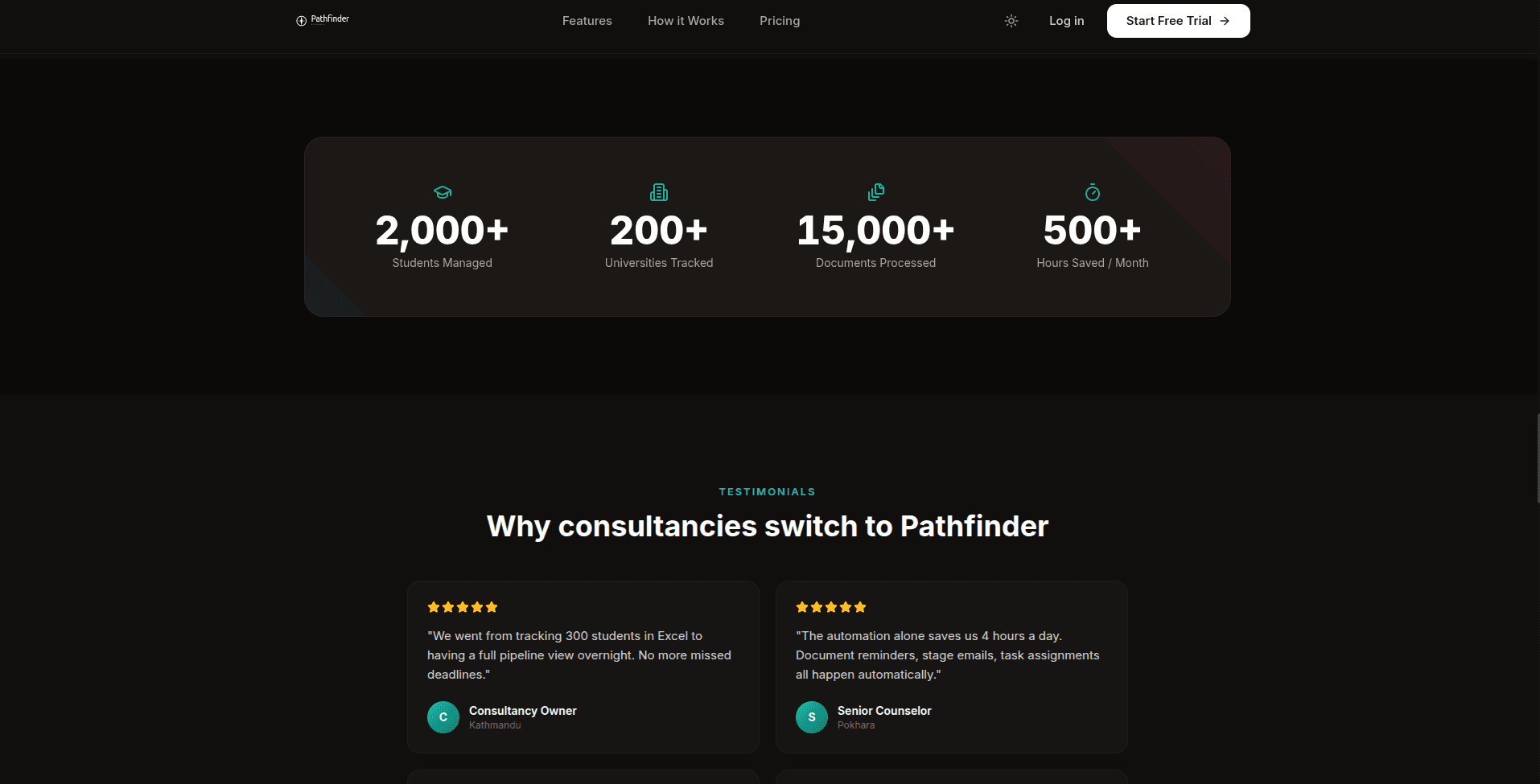
Pathfinder CRM by Qylantis is a CRM and student management platform built by Qylantis for education consultancies in Nepal. It helps consultancies manage student leads, counsellor follow-ups, applications, documents, payments, NOC tracking, visa stages, branches, and reports in one place.
Education consultancies need CRM software because manual systems become unreliable as the business grows. A CRM helps manage leads, follow-ups, student applications, documents, payments, visa stages, counsellor performance, and branch reports in one centralized system.
Excel can work for a very small consultancy, but it becomes risky as the number of students, counsellors, applications, documents, and payments grows. A CRM provides reminders, access control, tracking, reporting, and accountability that Excel cannot handle reliably.
A generic CRM may be enough for basic lead tracking, but it usually does not handle the complete study-abroad workflow. Education consultancies need student profiles, multiple applications, document checklists, NOC tracking, visa stages, payments, commission tracking, and branch reporting.
An education consultancy CRM should include lead management, counsellor assignment, follow-up reminders, student profiles, application tracking, document checklists, NOC tracking, payment tracking, commission tracking, branch access control, mobile access, and reporting dashboards.
Yes. A Nepal-focused education consultancy CRM should help teams track NOC status, documents, dates, corrections, and follow-ups so students and counsellors avoid last-minute confusion.
Yes. A CRM improves counsellor performance by showing assigned leads, follow-up activity, overdue tasks, student conversion, application movement, and overall productivity. It makes performance measurable instead of subjective.
Yes. Follow-up reminders are one of the most valuable CRM features. They help counsellors contact students on time and reduce lead leakage.
Yes. A proper consultancy CRM should track required documents, uploaded documents, missing documents, verified documents, and rejected documents. This reduces confusion during application and visa preparation.
Yes. A good CRM should track student payments, due amounts, payment methods, receipts, invoices, refunds, discounts, and branch-wise collections.
A strong education consultancy CRM should track expected commissions, received commissions, pending commissions, student-wise commission records, university-wise commission records, and agent or counsellor incentives.
Global CRMs are mature and powerful, but they often require customization for Nepali education consultancy workflows. A local CRM like Pathfinder CRM by Qylantis may fit better if your priority is Nepal-specific student management, NOC tracking, local support, branch operations, and consultancy-focused workflows.
No. Pathfinder CRM by Qylantis is especially useful for small and mid-sized consultancies that have outgrown Excel. It is a good fit for consultancies with around 5 to 50 counsellors that want better visibility, structure, and accountability.
CRM cost depends on the vendor, number of users, features, onboarding, migration, support, customization, and payment model. Consultancy owners should always ask for the total cost in NPR, including setup, training, taxes, and hidden charges.
A basic CRM implementation can begin within days, but proper adoption usually takes a few weeks. Data migration, training, workflow setup, and team discipline are more important than simply installing the software.
Before you choose CRM software for your education consultancy, answer these questions:
Does it fit the full student journey?
Can it manage multiple applications per student?
Can it track counsellor follow-ups?
Can it handle document checklists?
Can it track NOC status?
Can it track visa stages?
Can it track payments and dues?
Can it track university commissions?
Can it support multiple branches?
Can branch managers see only their own branch?
Can the owner see everything?
Can reports be generated without Excel?
Can counsellors use it from mobile?
Can all data be exported?
Is support available during Nepal business hours?
Is onboarding included?
Is migration support included?
Can you run a real 30-day pilot?
If the vendor cannot answer these clearly, do not buy.
Nepal's education consultancy industry is too important to run on broken spreadsheets, scattered WhatsApp chats, personal Gmail accounts, and memory-based follow-ups.
Students are making life-changing decisions. Parents are trusting consultancies with serious money. Counsellors are handling complex workflows. Owners are trying to grow while keeping control.
A weak system makes all of that harder.
The right CRM will not magically fix a badly managed consultancy. That is the hard truth.
But the right CRM will expose problems faster.
It will show which counsellors follow up properly, which leads are ignored, which applications are stuck, which documents are missing, which payments are pending, which branches are performing, and where the business is leaking money.
That visibility is powerful.
If you are running an education consultancy in Nepal and you have outgrown Excel, now is the right time to build a better operating system for your business.
Pathfinder CRM by Qylantis is built for exactly that.
Learn more here:
https://pathfinder.qylantis.com
Or contact: