How to Choose a CRM for Your Nepal Education Consultancy
If you run an education consultancy in Nepal, you have probably reached the point where Excel is no longer enough.
Maybe a student's offer letter sat in someone's personal Gmail for two weeks before you found out. Maybe a counsellor left and took half their leads with them because nothing was written down. Maybe you spent three days trying to figure out which agent introduced which student before paying out commissions. Maybe MoEST asked for a compliance report and you realized you had no clean way to produce one.
Whatever the breaking point, you are now Googling things like "best CRM for education consultancy Nepal" — and getting flooded with results that mostly do not apply to you.
This guide is for that moment.
I am the founder of Qylantis CRM, a software product built specifically for Nepal's education consultancies. So yes, I have skin in the game. But I have spent enough time talking to consultancy owners across Kathmandu, Pokhara, and Biratnagar to know that the real problem most owners face is not "which CRM should I buy." It is "how do I tell whether any of these CRMs will actually work for me before I commit money I cannot get back."
That is what this post is about.
Why generic CRMs fail Nepali consultancies
Walk into any consultancy in Putalisadak and you will see the same setup: WhatsApp on every phone, Excel sheets named "students final v3 (latest).xlsx," a shared Gmail account, paper files in metal cabinets, and maybe a wall calendar with deadlines circled in red pen.
When the owner finally decides to move to software, the first instinct is usually to buy whatever the biggest brand offers. Salesforce. HubSpot. Zoho. Pipedrive. These are excellent products. They are also built for sales teams in San Francisco and Mumbai, not for education consultancies in Nepal.
Here is what breaks when you try to use a generic CRM for a Nepali study-abroad consultancy.
The data model does not fit. A generic CRM has "Contacts," "Companies," and "Deals." Your business has Students, Universities, Programs, Applications, Visa Stages, Counsellors, and Branches. You can hammer your workflow into the wrong shape, but every counsellor will fight it for the next three years.
The compliance is wrong. MoEST requires NOC tracking. The Inland Revenue Department wants invoices in a specific Nepali format. The Privacy Act 2018 requires specific consent flows. NRB has rules about how you receive university commissions in foreign currency. None of the global CRMs know any of this exists.
The payment integration is missing. Your customers pay in NPR via Khalti, eSewa, IME Pay, mobile banking, or cash. Stripe and Razorpay work for IT exports but not for collecting from local students. A CRM that only knows about Stripe is a CRM that cannot help you bill anyone.
The dates are wrong. Half your operations run on Bikram Sambat. Visa appointments, MoEST submissions, festival closures. A CRM that only speaks Gregorian dates makes your counsellors translate constantly.
The pricing is wrong. A USD 50/user/month subscription that makes sense for a US sales team is roughly NPR 6,800 per counsellor per month. A 15-counsellor consultancy is paying over NPR 100,000 monthly for software, in a market where total revenue per student might be NPR 50,000 to 200,000. The unit economics simply do not work.
The support is in a different timezone. When something breaks at 2 PM Nepal time during peak intake season, you do not want to wait until 8 PM for a support agent in California to wake up.
This is not a criticism of those products. They are world-class. They are just not built for you.
What a CRM for a Nepali consultancy actually needs to do
Forget feature lists for a moment. Strip it down to first principles. A consultancy runs on five operational realities.
One. Many students at different stages. From "just walked in for inquiry" to "left for the UK last week." Every student is somewhere on that journey, and somebody on your team needs to know exactly where, every day.
Two. Many universities, many programs, many requirements. Each university has its own forms, deadlines, intake cycles, and document checklists. Tracking this across 30, 50, or 100 partner institutions is impossible without software.
Three. Multiple counsellors handling overlapping workloads. Suraj counsels for the UK. Bina handles Australia. Both of them sometimes work on the same student. Someone needs to own each application without double-counting commissions.
Four. Money flowing in two directions. Students pay you fees. Universities pay you commissions. Both need to be tracked, reconciled, and reported. Most consultancies leave money uncollected because the tracking is too hard.
Five. Compliance and reporting. MoEST audits, NOC processing, IRD invoices, FX inward remittance documentation, internal performance reviews. You need to produce these reports without a panic attack.
Any CRM you evaluate needs to do these five things well. Everything else is a nice-to-have.
The 12 questions to ask any CRM vendor before you pay
Most consultancy owners who buy bad software did not ask the right questions before signing the contract. Here is the question list. Print it. Bring it to every demo.
1. Is this software built specifically for education consultancies, or is it a generic CRM with an "education template"?
If the answer is "generic CRM with template," walk away. Templates are a marketing tactic, not a product strategy. The data model underneath is still wrong.
2. Where are your servers located, and what happens to my data if your company shuts down?
You need to know your data is recoverable in NPR-denominated reality. If the vendor cannot give you a clean export of all your data within 24 hours of asking, that is a red flag.
3. Can my counsellors update student status from their mobile phones?
Counsellors are in university visits, at student homes, at education fairs. If the CRM only works on a desktop, half your data will be entered hours late or never. Mobile-native is non-negotiable in 2026.
4. How do you handle Khalti, eSewa, and bank-transfer payments?
If the answer is "we integrate with Stripe," they do not understand your market.
5. Do you support Bikram Sambat dates alongside Gregorian?
Small thing. Massive operational impact. Tells you whether the team has actually worked with Nepali businesses.
6. Can I generate IRD-compliant invoices directly from the system?
If you have to copy-paste data from the CRM into a separate accounting system to produce a tax invoice, you have not bought a CRM, you have bought a fancy spreadsheet.
7. How do you track commissions from universities back to specific students and counsellors?
Ask for a demo of the entire flow: student admitted → university pays commission → reconciliation → counsellor incentive calculation. If the demo skips steps, the feature does not really exist.
8. What happens during MoEST audits? Can I produce an NOC compliance report on demand?
If they look confused when you say "MoEST," they have not built for you.
9. Can branch managers see only their branch's data, while owners see everything?
Multi-branch consultancies need proper role-based access control. This is a deal-breaker if missing.
10. What is the actual cost in NPR, including taxes, for a 15-counsellor team?
Get the all-in price. Many SaaS vendors hide implementation, training, and "premium support" fees that double the sticker price.
11. Who provides support, in what timezone, and through what channels?
You want WhatsApp or Viber support during Nepal business hours, not email tickets answered in 48 hours from Bangalore.
12. Can I see a real reference customer in Nepal who is currently using your software?
If they cannot name one, you would be a guinea pig. Sometimes that is fine — early customers get sweetheart deals. Just know what you are signing up for.
The four buying mistakes I see consultancies make
After dozens of conversations with owners who have tried and abandoned different CRMs, four patterns repeat.
Buying based on a polished demo without piloting
A 30-minute demo always looks good. The real test is whether your counsellors can use it on a Tuesday morning when 12 walk-ins are happening at once. Demand a 30-day pilot with real data before signing an annual contract.
Underestimating data migration effort
Moving from Excel to a CRM is not a 2-hour task. It is a 2-week project. If the vendor does not offer migration support, budget for it yourself or do not buy.
Buying for features instead of workflow
A CRM with 500 features that does not match how your team actually works will be abandoned in 90 days. A CRM with 50 features that perfectly matches your workflow will be used for years. Workflow fit beats feature count, every time.
Ignoring the lock-in question
Some vendors structure their data export so that leaving is technically possible but practically impossible. Ask for a sample export file before you sign. If they cannot produce one in your evaluation, do not trust them with three years of your business data.
Where Qylantis CRM fits in this picture
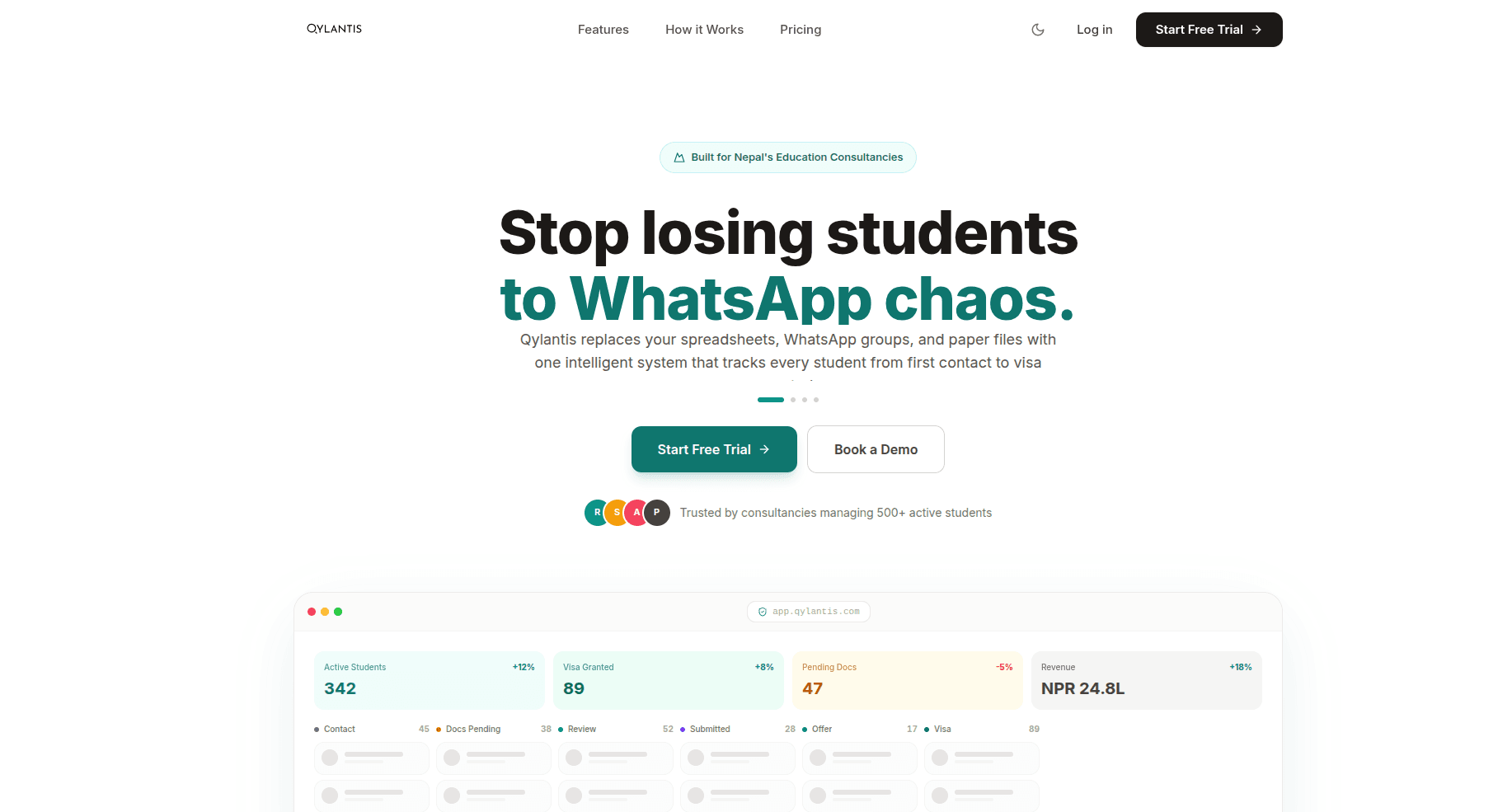
I will be transparent. Qylantis CRM is a young product. We do not have the brand recognition of Salesforce. We do not have a thousand-customer reference list. What we have is a product designed from the first line of code for Nepali education consultancies, and a founder you can reach directly when something breaks.
We handle the things generic CRMs do not. Khalti and eSewa billing. Bikram Sambat dates. IRD-format invoicing. MoEST NOC tracking. NPR-denominated pricing that makes sense for a 15-counsellor team. We have native iOS and Android apps so counsellors can update student status from anywhere. Branch-level access control comes built in. And we are based in Kathmandu — when you call us during business hours, someone who actually built the product picks up.
We are not the right fit for everyone. If you are a 200-counsellor consultancy with a dedicated IT team and integration requirements with five other systems, you are probably better served by a more mature platform. But if you run a 5 to 50 counsellor consultancy in Nepal and you have outgrown Excel, we would love to talk.
We are signing pilot partners now and offering 50% off Year 1 to the first ten consultancies who join us. Not because we are desperate — because we want partners who will help us shape the next 12 months of the product. The earliest customers always shape the product more than the latest ones do.
What you should do this week
Whether or not you ever talk to us, do these three things this week.
Start by listing your actual workflow. Not the workflow you think you should have — the workflow you actually have. Where do leads come from? Who handles them? When does information get lost? Most owners cannot answer these questions clearly, and that is exactly why generic CRMs fail them.
Take three demos. Not ten. Three. Pick one global product (Zoho, Salesforce, HubSpot), one Indian product (Meritto, LeadSquared), and one local product. Use the 12 questions above. Watch how each vendor reacts when you ask about MoEST and Khalti.
Run a 30-day pilot with the one that fits best. Real students, real applications, real counsellors using it. At the end of 30 days you will know — not from feature lists, but from actual use.
If you find the right software, your consultancy will run smoother for years. If you do not, you will have wasted weeks but learned exactly what you actually need. Either way, you have moved forward.
Either way, I am happy to talk. You can reach me directly at founder@qylantis.com, or visit qylantis.com to learn more about what we are building.
Good luck out there. Nepal's education consultancy industry sends over a hundred thousand students abroad every year, handles tens of billions of rupees in foreign exchange, and remains almost entirely invisible to global software makers. There has never been a better time to demand software that was actually built for you.