Why we're building Qylantis CRM for Nepal's education consultancies
1. Hook
Imagine a counsellor in a cramped Putalisadak office at 4:30pm. She opens three WhatsApp groups, two Excel files titled “Applications_v2_FINAL_really.xls” and a shared Gmail inbox. A student’s admission offer is in one chat, the scholarship document in another, and the visa checklist in a photo. The student’s flight is next week. The counsellor spends an hour piecing together which document is current, who paid what, and which branch is handling the follow-up. Meanwhile, commission calculations are in a separate ledger, and the accountant wants IRD-formatted invoices. This is how thousands of study-abroad consultancies in Nepal still run their business — messy, fragile, and expensive in time and trust.
2. The problem, in concrete terms
There are roughly 3,000–4,000 MoEST-licensed education consultancies operating in Nepal. In FY 2023/24, the Ministry of Education issued 112,593 No Objection Certificates (NOCs) for students going abroad. In the first five months of FY 2024/25 alone, roughly NPR 47.34 billion left the country for education. That’s not a niche; it’s a major human and economic flow. Yet most of the consultancies that handle that flow run on Excel, WhatsApp, paper files, and Google Sheets.
That mismatch creates predictable, expensive problems:
- Operational friction: Counsellors waste hours per student hunting for the right file or chat message. Follow-ups slip. Deadlines get missed.
- Compliance risk: MoEST NOCs, NRB foreign-exchange rules, and embassy/visa documentation don’t tolerate sloppy records. Manual processes invite penalties.
- Accounting headaches: Commissions, refunds, multi-branch accounting, and IRD-format invoices are shoehorned into spreadsheets and manual calculations.
- Fragmented data: No single source of truth for a student’s lifecycle — from inquiry to enrollment to visa boarding.
- Poor visibility: Owners can’t measure counsellor performance, branch KPIs, conversion funnels, or cash flow reliably.
I’ve spoken to counselling owners who describe the same refrain: “We know we’re losing students and time, but we don’t have software that fits our workflow — and if we buy a CRM, it’s either built for a different market or costlier than we can justify.”
3. Why the existing CRMs miss the mark
There are plenty of CRMs. Zoho and Salesforce are powerful but generic and expensive when you try to model Nepal-specific processes. LeadSquared and similar products are often tuned for Indian or Western flows — different fee structures, different payment rails, different regulatory needs. Then there are regional players who try to be everything to everyone but end up being one-size-fits-none.
The gaps that matter are local and technical:
- Payments: Consultancies take payments on Khalti, eSewa, and local bank transfers. Integrations are clumsy or absent.
- Dates: Many stakeholders expect Bikram Sambat dates on documents and reports; converting everything back and forth is error-prone.
- Compliance: MoEST NOC issuance and retention, NRB foreign exchange inputs, and embassy documentation requirements need structured fields and audit trails.
- Accounting: IRD-format invoicing and commission accounting across branches are requirements, not nice-to-haves.
- User roles: Branch managers, counsellors, accountants, field agents, and owners each need tailored views and permissions.
Putting an off-the-shelf CRM on top of these realities creates more work, not less.
4. What we’re building and why it matters
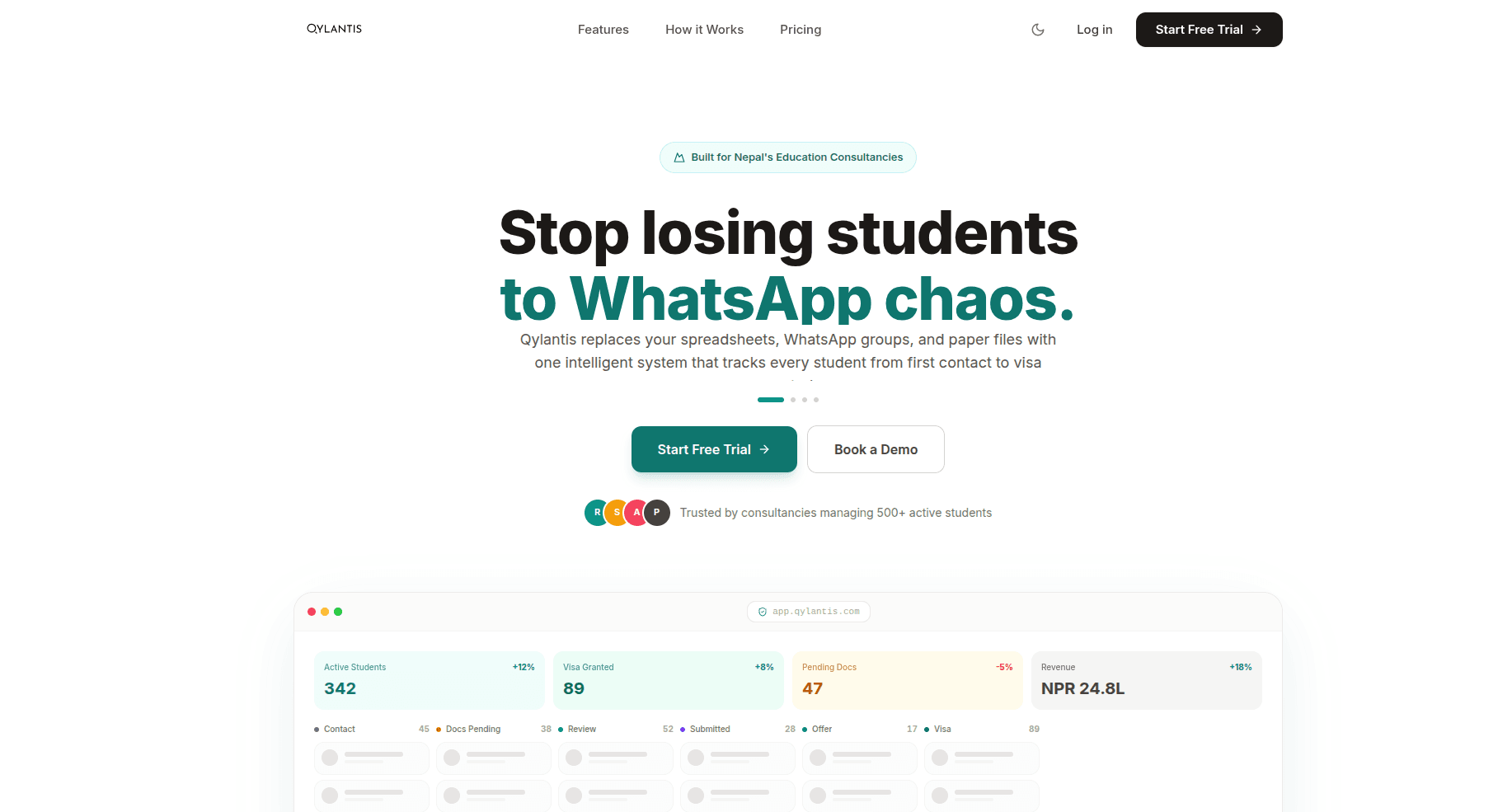
Qylantis CRM is a multi-tenant SaaS platform built from the ground up for Nepal’s education consultancies. We focused on solving the real work, not on buzzwords. Concretely, the product handles:
- Students and applications: Single source of truth for every student, including documents, offers, scholarships, and visa statuses.
- Universities and programs: Structured records for universities and program-specific checklists.
- Visa workflows: Step-based workflows customized for each destination country, with reminders and document tracking.
- Counsellor performance: Lead-to-enrolment funnels, conversion rates, contact histories, and KPIs by person or branch.
- Branch management: Multi-branch visibility with permissions and reconciliation tools.
- Commission accounting and invoicing: Automated commission calculations, payroll-ready reports, and IRD-compatible invoices.
- Compliance features: Fields and audit logs for MoEST NOC numbers, NRB-related foreign-exchange records, and document retention policies.
Technically, it’s production-ready: FastAPI + PostgreSQL backend, a React web app, and React Native mobile apps for counsellors on the go. We run on Google Cloud Run. There are five user roles, 200+ REST endpoints, and the site is live at crm.qylantis.com.
Why does that stack matter? Because reliability, speed, and maintainability matter in small businesses. Counsellors shouldn’t be slowed down by laggy UIs or fragile spreadsheets. Owners shouldn’t have to wrestle with background jobs or database tuning. We built a product that aims to be fast, predictable, and simple to operate.
5. Our approach — pragmatic, not dogmatic
We’re early. We have zero paying customers. That’s honest and important. We’ve spent months talking to consultancies, prototyping workflows, and building the product based on those conversations. But building something that fits these businesses is not a one-off engineering exercise; it’s a learning process.
So our approach is simple:
- Start with the real work: Model the student lifecycle and the financial flows that matter to owners and accountants, not hypothetical “lead scoring” metrics that don’t map to reality.
- Localize fully: Integrations with Khalti/eSewa, support for Bikram Sambat, IRD-ready invoices, and MoEST NOC fields are first-class features.
- Make it auditable: Every NOC, payment, and document has an audit trail so consultancies can meet compliance and build trust with students and regulators.
- Ship small, iterate fast: We push features, watch how counsellors use them, and refine. We don’t ask customers to change how they work; we adapt to how they already work and make it better.
- Be transparent about pricing and support: No surprise fees. Training that actually reduces support requests.
6. The product today — what you can expect
If you log into crm.qylantis.com you’ll see a working product that supports day-to-day operations:
- Student profiles with document dashboards and a timeline of interactions.
- Application tracking with program-level checklists.
- A simple invoice generator that exports IRD-friendly documents.
- Commission reports by student, counsellor, or branch.
- Mobile-friendly interfaces for counsellors to capture notes and uploads during meetings.
- Role-based access so accountants don’t see incomplete applications, and counsellors don’t edit accounting fields.
It’s not perfect. Some features are still being polished. But it’s usable and built for the specific problems I keep seeing in Nepal.
7. Where we need help — pilots, feedback, and honesty
We need two things more than anything: customers and feedback.
- Customers: We’re looking for 10 consultancies to trial Qylantis as pilot partners. In exchange for early access, we will work closely with you to tune the product to your workflow, add missing reports, and help migrate your existing records.
- Feedback: If you’re a counsellor, branch manager, or owner, talk to us. Tell us where the product makes your day lighter and where it still feels like software. We’ll act on the sharp, specific feedback first.
- Integrations and partnerships: We’ll prioritize integrations that save real time — payment providers, immigration consultants, and university portals. If you’re a partner, let’s talk.
To be clear: we will not force consultancies into a single rigid workflow. We’ll build flexible defaults and practical migrations from Excel/WhatsApp/Google Sheets. And we’ll make onboarding a real service, not a set of docs buried behind a login.
8. Our values — why Kathmandu, why now
I’m proud we’re building this from Kathmandu. Nepal has a huge pool of engineering talent, intimate domain knowledge of our market, and a cultural advantage: we understand the paperwork, the festivals, the dates, and the payment rails. That matters when you’re building software that replaces paper and chat messages with reliable processes.
We’re optimistic about South Asia’s future. The student flows, the remittances, and the entrepreneurial energy here are strengths. Software that helps local businesses capture more value and reduce friction benefits students, consultancies, and the broader economy.
9. If you run a consultancy (or know someone who does)
If you run a consultancy and any of this resonates — missed follow-ups, late invoices, confusing commission sheets — I’d love to hear from you. We’re offering pilot access, personalized onboarding, and priority feature support to our first partners.
Visit crm.qylantis.com to request a demo or sign up for early access. If you prefer to write, reply to this post or find us on LinkedIn. We’ll come to your office, watch how you work, and bring back changes that save hours, money, and headaches.
10. Final note — a small, honest bet
We’re not trying to build the next billion-dollar platform overnight. We’re trying to build software that a counsellor in Putalisadak can rely on every afternoon when a student walks through the door. If that sounds modest, it’s deliberate: small wins compound. Better records lead to fewer missed deadlines, which lead to fewer refunds and more reliable revenue, which makes consultancies healthier and students’ journeys less stressful.
If you run a consultancy, try us. If you’re an investor or a partner, I’d love to talk about how software can make this industry more professional, auditable, and scalable — while being proudly built from Kathmandu.
— Founder, Qylantis Pvt Ltd
crm.qylantis.com | blog.qylantis.com